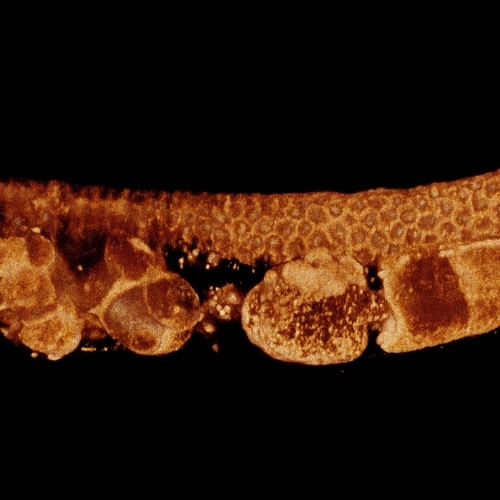
Capturing Fast Biological Dynamics in Real Time with Viventis SCAPE
Professor Elizabeth M. Hillman
Chair, Department of Imaging Sciences, St Jude Children's Research Hospital
Read BioElizabeth has been a Professor of Biomedical Engineering and Radiology at Columbia University since 2017. She has held the Herbert and Florence Irving Professorship at the Mortimer Zuckerman Mind Brain Behavior Institute at Columbia University since 2020. She developed tools for high-speed imaging of activity across the entire brain and pioneered the development of SCAPE microscopy, which combines light-sheet with laser-based confocal microscopy.
Close
Dr Sarah J. Untucht
Application Scientist, Leica Microsystems
Read BioSarah studied Biotechnology with a focus on Biomedical Science and holds a PhD in Cell Biology from Heidelberg University. Her research covered multicellular models of the human neuromuscular junction and glial cell differentiation, using advanced imaging methods. At Leica Microsystems, she is an Application Scientist, supporting the development of innovative 3D microscopy systems.
CloseLearn the optical principles behind SCAPE microscopy and see it demonstrated, with scientific results and practical insights from the technology’s inventor and a Leica applications expert.
In this webinar, you’ll:
-
Learn how SCAPE achieves real-time volumetric imaging with low phototoxicity using a single objective
-
Discover the key scientific results that SCAPE microscopy has enabled to date
-
See Viventis SCAPE demonstrated in action with intuitive software integration
This is the second and final session in the webinar series on Viventis SCAPE, a single-objective light-sheet microscope that enables high-speed, low-phototoxicity 3D live imaging.
The presentation is divided into two segments. In the first, Professor Elizabeth Hillman, inventor of swept confocally aligned planar excitation (SCAPE) microscopy, introduces the optical and engineering principles behind the technique and highlights key scientific results that SCAPE has enabled to date.
In the second, Dr. Sarah Untucht from Leica Microsystems demonstrates Viventis SCAPE in action, showing how single-objective light-sheet imaging, combined with intuitive software integration, makes high-performance volumetric microscopy more accessible for working researchers.
Together, the two segments give attendees both a grounded understanding of how SCAPE works and a practical view of what the Viventis SCAPE platform can do in the lab.