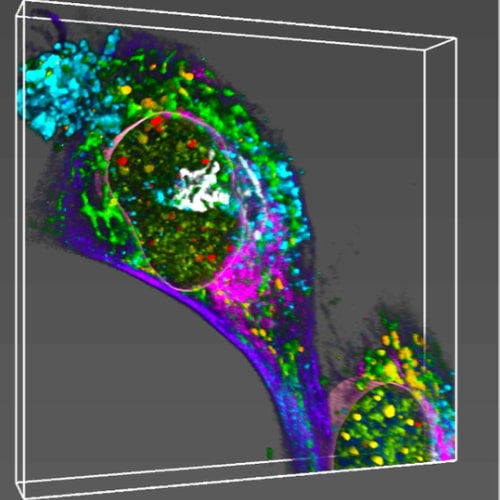
A DNA-Based Toolkit for Spatial Molecular Analysis

Sinem Saka
Group Leader, EMBL Heidelberg
Read BioSinem is a Group Leader in the Genome Biology Unit at the European Molecular Biology Laboratory (EMBL) Heidelberg, where she leads an independent program in quantitative spatial cell biology. She co-leads the EMBL GenTechDev OpenLab and the MULTI-SPACE Platform and is a co-founder of the European Society of Spatial Biology. Sinem earned her Ph.D. in Germany from the University of Göttingen and the International Max Planck Research School in 2013 before conducting postdoctoral research at the Wyss Institute at Harvard University.
CloseDiscover how engineered DNA tools are opening new ways to map spatial molecular organization and function inside intact biological samples.
In this webinar, you’ll learn how:
-
Programmable DNA barcoding and amplification enable highly multiplexed spatial imaging of nucleic acids and proteins
-
DNA barcodes and tunable amplification can streamline multispectral panel optimization and improve spectral unmixing
-
Light-Seq and ProPER enable spatial analysis of selected regions, molecular proximity, and regulatory states
Cellular function is not set by molecular composition alone, but by how molecules are arranged in space. Most molecular measurements still require pulling biomolecules out of their native context, which erases the spatial organization that underlies cellular regulation.
This webinar presents a connected set of methods for measuring molecular organization inside intact cells and tissues. A central strategy in our work is the repurposing of DNA as an engineering material: by exploiting programmable DNA hybridization and orthogonal sequence design, we build methods for DNA barcoding, amplification, and writing, creating an interoperable toolkit for spatial molecular analysis.
SABER delivers highly multiplexed imaging of nucleic acids and proteins using branched DNA amplification via enzymatically generated linear DNA concatemers. Recently, we leveraged Immuno-SABER to develop a new multispectral imaging framework for robust panel development and quantitative evaluation of unmixing.
Orthogonal DNA barcodes decouple target labeling from fluorophore detection, so a panel can be optimized and its fluorophores swapped on the same sample, streamlining panel optimization, ground-truth image generation, and unmixing performance assessment. DNA-based amplification can further tune the signal intensity per target, thereby correcting the imbalance between overlapping channels and improving unmixing.
Light-Seq allows light-directed sequencing of optically selected cells and subcellular compartments. ProPER enables in situ recording of molecular proximity and regulatory states of molecules. Together, these technologies provide complementary measurements of molecular composition, localization, interaction, and function directly within intact cells and tissues.